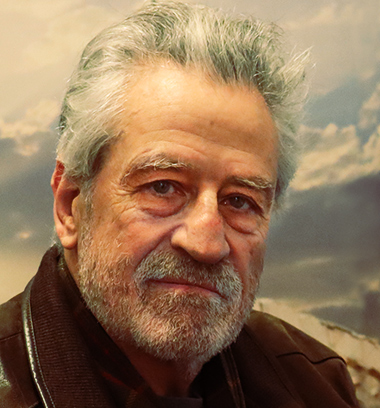
Richard Poynder is an independent journalist and blogger specialising in information technology,
scholarly communication, professional
online database services,
open science,
e-Science, and
intellectual property. Richard takes a particular interest in the
Open Access movement, whose development he has been following for more than a decade. More information is available here.
Recent Articles and Interviews
Open Access: Information wants to be free ?
(Open & Shut?, Wednesday, December 02, 2020)
Earlier this year I was invited to discuss with Georgia Institute of Technology librarian Fred Rascoe my eBook Open access: Could defeat be snatched from the jaws of victory? for Lost in the Stacks, the research library rock and roll show he hosts.
Prior to the interview, Rascoe sent me a list of questions. As we did not have time to discuss them all during the interview, I decided to publish my answers on my blog. With the greater space available I also took the opportunity to expatiate at considerable length in doing so. This turned into another eBook. Read more »
Community Action Publishing: Broadening the Pool
(Open & Shut?, Wednesday, November 04, 2020)

We are today seeing growing dissatisfaction with the pay-to-publish model for open access. As this requires authors (or their funders or institutions) to pay an article-processing charge every time they publish a paper it is felt to be discriminatory, especially for non-funded researchers and those based in the Global South (see, for instance, here, here and here).
As a result, various alternative approaches are emerging intended to move away from APCs, including crowdfunding and membership schemes. Here institutions are asked to commit to paying an annual fee to a publisher, with the aim of pooling sufficient funds to cover the costs of making all the papers in a journal open access. Read more »
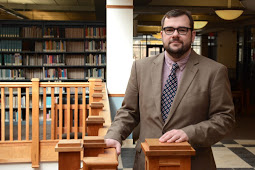
Unbundling the Big Deal: An interview with SUNY’s Shannon Pritting
(Open & Shut?, Thursday, July 30, 2020)
The Big Deal, has been a topic of heated discussion among librarians for some twenty or more years now. When first introduced, the attraction of the Big Deal was immediately obvious, since it allows a library to buy its faculty access to most, if not all, of a publisher’s journals at a much lower “cost per article” (discounted) rate. From the start, however, there were doubters.
In 2001, the Director of Libraries at the University of Wisconsin, Madison, Kenneth Frazier, warned warned the library community of the dangers of signing big deals, or any comprehensive licensing agreement, with commercial publishers. Read more »
PLOS CEO Alison Mudditt discusses new OA agreement with the University of California
(Open & Shut?, Wednesday, February 19, 2020)

The Public Library of Science (PLOS) and the University of California (UC) have today announced a two-year agreement designed to make it easier and more affordable for UC researchers to publish in the non-profit open-access publisher’s suite of seven journals.
Under the agreement – which is planned to go into effect this Spring – UC Libraries will automatically pay the first $1,000 of the article processing charge (APC) incurred when UC authors choose to publish in a PLOS journal. Read more »
Open access: Could defeat be snatched from the jaws of victory?
(Open & Shut?, Monday, November 18, 2019)
When news broke early in 2019 that the University of California had walked away from licensing negotiations with the world’s largest scholarly publisher (Elsevier), a wave of triumphalism spread through the OA Twittersphere.

The talks had collapsed because of Elsevier’s failure to offer UC what it demanded: a new-style Big Deal in which the university got access to all of Elsevier’s paywalled content plus OA publishing rights for all UC authors – what UC refers to as a Read and Publish agreement. In addition, UC wanted Elsevier to provide this at a reduced cost. Given its size and influence, UC’s decision was hailed as “a shot heard around the academic world”. Read more »
The OA Interviews: K. VijayRaghavan, Principal Scientific Adviser, Government of India
(Open & Shut?, Thursday, October 31, 2019)
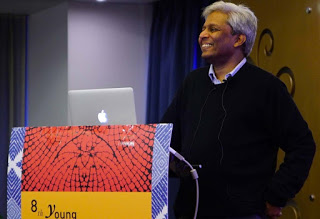
India has announced that it will not, after all, be joining cOAlition S. Instead it will focus on developing an open-access solution better suited to its needs. What has changed?
Last year a group of European research funders calling themselves cOAlition S launched a radical new open-access initiative dubbed Plan S. The aim: to ensure that all research papers resulting from work they fund are made immediately freely available on the internet. Read more »
The Open Access Interviews: Edith Hall
(Open & Shut?, Monday, August 05, 2019)
Open access to research papers in STM journals has always been a controversial topic. When the focus shifts to humanities research, and to monographs, the temperature rises still further – as evidenced by This emotionally charged post by OA advocate Martin Eve in response to a British Academy document on the European OA initiative Plan S.
Why is open access so contentious? In large part, I think, because although OA began as a bottom-up revolution it was never widely embraced by researchers. However, OA advocates managed to persuade governments, funders and institutions that their colleagues should be compelled to embrace open access. This has seen a series of ever more stringent OA mandates being imposed on researchers, increasing the bureaucratic burden on them (amongst other things). Read more »
The OA interviews: Arianna Becerril-García, Chair of AmeliCA
(Open & Shut?, Tuesday, May 21, 2019)
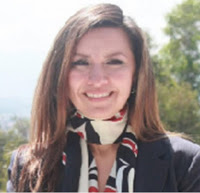
A professor in the School of Political and Social Sciences at the Autonomous University of the State of Mexico (UAEM), Arianna Becerril-García is also the Executive Director of Redalyc, the Network of Scientific Journals from Latin America and the Caribbean, Spain and Portugal. Redalyc is a regional open access portal for the social sciences and humanities that indexes 1,305 local journals and hosts the full texts of more than 650,000 articles.
In addition, Becerril-García is the Chair of a new project called AmeliCA (Open Knowledge for Latin America and the Global South). AmeliCA’s goal is to propagate the Redalyc model to the more than 15,000 journals in the region and elsewhere in the Global South. Read more »
Why did Riksbankens Jubileumsfond decide to leave cOAlition S?
(Open & Shut?, Thursday, June 06, 2019)
Last September a group of (mainly) European funders (cOAlition S) launched a new open access initiative called Plan S. The goal was to make all publicly funded research open access by 2020. And to that end, a month later (November) a set of draft implementation guidelines for the plan were published.

Plan S proved controversial and, amongst other things, led to a petition of protest being launched.
To help ease the way and encourage buy-in, therefore, cOAlition S opened the guidelines up for public consultation. This attracted more than 600 responses and saw the publication of revised guidelines last week (31st May). Read more »
eLife and my unanswered questions
(Open & Shut?, Tuesday, April 02, 2019
Reporting on the scholarly publishing world can be a frustrating business these days, not just because the business model for journalism has all but collapsed but because scholarly publishers seem to be becoming increasingly reluctant to engage with reporters in a meaningful way, especially where the topic is open access. Their clear preference is to communicate by press release or managed events like webinars.
In fact, this has been the favoured model of commercial legacy publishers for quite some time now. The pity is that it appears to be becoming the modus operandi for non-profit OA publishers and OA initiatives too. Since the raison d’être of OA is openness and transparency this is unfortunate. If nothing else, it smacks of hypocrisy. Read more »
Plan S: What strategy now for the Global South?
(Open & Shut?, Friday, February 15, 2019)
Since the 2002 Budapest Open Access Initiative (BOAI) the OA movement has had many successes, many surprises, and many disappointments. OA initiatives have also often had unintended consequences and the movement has been beset with disagreement, divisiveness, and confusion.
In that sense, the noise and rancour surrounding Plan S is nothing new, although the discord is perceptibly greater. What seems clear is that Plan S raises challenging questions for those in the Global South. Read more »
The OA Interviews: Peter Mandler
(Open & Shut?, Tuesday, December 11, 2018)
In September a new European open access initiative called Plan S was announced. The stated goal is to ensure that from 2020, "scientific publications that result from research funded by public grants must be published in compliant open access journals or platforms."
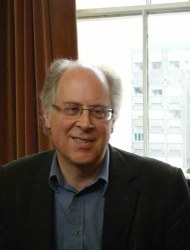
In other words, the aim is to make all publicly-funded European research papers freely available to the world immediately on publication. Plan S signatories currently include 13 European funders and two charitable foundations, who have banded together as cOAlition S in order to oversee and promote the initiative. One of the first to sign up was UK Research England and Innovation (UKRI) – an organisation formed earlier this year to bring together in one unified body the seven UK research councils, as well as Innovate UK and the research and knowledge exchange functions of the Higher Education Funding Council for England (HEFCE). Read more »
The OA Interviews: Frances Pinter
(Open & Shut?, Sunday, November 25, 2018)
In 2012 serial entrepreneur Frances Pinter founded a new company called Knowledge Unlatched (KU). The goal, she explained in 2013, was to “change the way we fund the publishing of quality content” for book-length publications, and in a way that would allow them to be made open access.

With that end in mind, Pinter launched a pilot project in which research libraries were invited to pool money to fund the “fixed costs” of publishing monographs. By doing so, Pinter reasoned, PDF and HTML versions of these “unlatched” books could be made freely available on the Web, but print and other premium versions would continue to be sold in the traditional manner. And those libraries that contributed to the pool would earn the right to buy the premium versions at a discounted price. Read more »
The OA Interviews: Arul George Scaria
(Open & Shut?, Sunday, November 18, 2018
One common criticism of the open access and open science movements is that they tend to take a standardised view of science and scholarship, and so propose one-size-fits-all approaches when advocating for ways of making research and the research process more open and transparent. This often poses significant challenges for, for instance, researchers in non-STEM disciplines. It is also often deeply problematic for those based in the global South.
This is one of the reasons why open access has become a source of considerable conflict and divisiveness, particularly as more and more researchers find themselves subjected to increasingly demanding and standardised OA mandates. Read more »
Plan S and Researchers’ Rights: (Re)Framing Academic Freedom
(Open & Shut?, Monday, November 12, 2018)
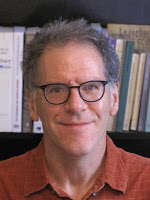
The announcement of Plan S has generated many much needed (and much heated) discussions. I’m pleased to observe that these don’t concern the relevance of open access, whose wide-ranging benefits now seem to be almost universally acknowledged, but only potentially negative side-effects of the massive, if not global, shift to open access that the plan hopes to bring about.
Though many aspects of the plan are somewhat unclear, and most details of its implementation are still being drafted, what we do know already raises various worries. One is a possible conflict with academic freedom. Read more »
It is for publishers to provide Plan S-compliant routes to publication in their journals.
(Open & Shut?, Wednesday, October 10, 2018)
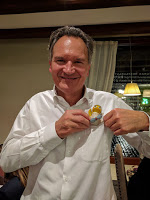
On 4th September, Robert-Jan Smits, the Open Access Envoy of the European Commission, and Marc Schiltz, the President of Science Europe, announced Plan S, a radical new initiative designed to ensure that by 2020 all research papers arising from funding provided by 11 (now 13) European funders are made open access immediately on publication.
The plan is based on 10 clear principles but short on detail as to how those principles will be implemented. If successful, however, Plan S could have a dramatic impact on both publishers and researchers. For instance, reported Nature, as written the 10 principles could see European researchers barred from publishing in 85% of journals, including influential titles such as Nature and Science. Read more »
Paywall: The Business of Scholarship — a review
(Open & Shut?, Saturday, September 11, 2018)
My review of Paywall: The Business of Scholarship has been published in Nature. Below are the first two paragraphs. The full review can be read here.
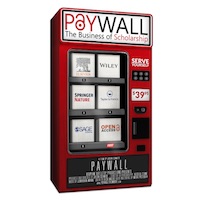
Billed as a documentary, Paywall would be more accurately described as an advocacy film. Its intention seems to be to persuade viewers that the paywalls that restrict access to journal content online are an unnecessary hangover from the print era, and now serve only to perpetuate the excessive profits that legacy publishers such as Elsevier, Wiley and Springer Nature make from the public purse. Read more »
The OA Interviews: Virginia Steel, Norman and Armena Powell University Librarian at UCLA
(Open & Shut?, 2. Sunday, July 29, 2018)
Those wishing to go directly to the Q&A with Virginia Steel can access the pdf here and then click on the link at the top of the document.
Who would have thought in 2002 that the sixteen “open” enthusiasts who that year launched the Budapest Open Access Initiative were about to unleash on the world a chain of events that some believe will eventually upend the 350-year old scholarly publishing system, and has in the meantime thrown researchers, librarians, universities, funders, governments and scholarly publishers into what at times looks like a dance of death. Read more »
Falling prey to a predatory OA publisher: Individual failure or community problem?
(Open & Shut?, Friday, July 20, 2018)
Depending on whom you speak to, so-called predatory publishing is a serious threat to the scientific record, a minor irritant, or an elitist misunderstanding.
Thus, while some argue that predatory publishers represent “the dark dangerous force” of scholarly publishing, others insist that, by contrast, they have introduced valuable low-cost journals that have levelled the playing field for less privileged members of the research community. As such, the latter say, the journals they publish would be better described as “new wave journals” or examples of “innovation in publishing”, not predatory journals. Read more »
OA Big Deals: VSNU embraces greater transparency
(Open & Shut?, Monday, July 09, 2018)
Over three months ago (in March) the Association of Universities in the Netherlands (VSNU) published a very brief news item announcing that it had reached agreement with Springer Nature on a new OA Big Deal.
Curious as to the details of the agreement, I invited VSNU to answer some questions, both about the Springer Nature deal and VSNU’s failure to reach agreement with the Royal Society of Chemistry (RSC), concerning which another short news item had been published at the same time. Read more »
The OA Interviews: Taylor & Francis' Deborah Kahn discusses Dove Medical Press
(Open & Shut?, Tuesday, June 12, 2018)
The open-access publisher Dove Medical Press has a controversial past and I have written about the company on a number of occasions.
When Dove was acquired by Taylor & Francis last September it was assumed (by me at least) that controversy had become a thing of the past for the publisher. Read more »
Six questions about openness in science
(Open & Shut?, Monday, May 14, 2018)

Recently I was contacted by a student from a Russian university who is writing a dissertation on the influence of open access on modern scientific communication. She sent me six questions... Read more »
North, South, and Open Access: Jeff MacKie-Mason responds from California
(Open & Shut?, Friday, May 04, 2018)
This is the last part of an experiment in a matched interview process. It consists of Q&As with two OA advocates, one from the global North and one from the global South, along with their responses to each other’s Q&A.
The first Q&A was undertaken with Jeffrey MacKie-Mason, UC Berkeley’s University Librarian and Chief Digital Scholarship Officer, and can be read here. Read more »
North, South, and Open Access: The view from Egypt with Mahmoud Khalifa
(Open & Shut?, Tuesday, April 24, 2018)
At the end of last year I was contacted by Jamila Jaber, Library Director at the Islamic University of Lebanon (IUL), who asked me if I would consider doing an interview "with two researchers, one from a 'developed country' and one from a ‘developing country’ (from the Arab world for example)."
The aim, she explained, should be to allow for a discussion about scholarly communication and open access from two geographically different points of view. Read more »
North, South, and Open Access: Mahmoud Khalifa responds from Egypt
(Open & Shut?, Thursday, April 19, 2018)

As I have previously reported, more and more countries in the global North are coming to the conclusion that if universal open access is to be achieved any time soon they are going to have to persuade or compel legacy scholarly publishers to convert all their subscription journals to gold OA, by means of a global "flip". Read more »
Blog
Books
Radio
Presentations
|